A Digital Security Passport is a governed digital record that links a real person to the organizations, roles, assignments, training, permits, vehicles, credentials, zones, and time limits relevant to physical security. It does not grant permanent universal access. It supplies current, explainable evidence so each checkpoint can decide whether the verified person is authorized for this place, purpose, and moment.

A Digital Security Passport is not a travel passport
The term can be confusing. In this context, a Digital Security Passport is not a government travel document, an e-passport, a vaccine certificate, or a product passport. It is an enterprise physical-security concept: a trusted relationship layer between a person and the conditions that govern access to facilities, zones, assets, and controlled work.
It should answer more than “who is this?” A useful passport can answer:
- Identity: Has this person been resolved to one trusted record and verified at the checkpoint?
- Relationship: Are they an employee, contractor, visitor, driver, tenant, service provider, or another approved population?
- Purpose: Why are they here—an assignment, scheduled visit, delivery, maintenance activity, or permitted job?
- Readiness: Are the applicable company approval, induction, competence, training, documents, escort, and safety conditions current?
- Entitlement: Which site, zone, door, lane, vehicle route, or work area may they use, and during what period?
- Evidence: Which facts, policy version, approver, device, and event led to the decision?
It is also not another master database
HR should remain authoritative for employment. Learning systems should remain authoritative for training. Contractor management should own company and worker readiness. Visitor management should own the visit. ePTW should own permission to perform defined work. Physical access control should own doors, readers, controllers, and passage rules.
The passport does not need to copy every field from every system. It can resolve the person, reference or consume the minimum facts needed, apply a versioned policy, and issue a scoped entitlement or decision. This distinction matters because copying everything creates a new source of truth that quickly becomes stale.
| Control | What it proves well | What it cannot prove alone |
|---|---|---|
| Card or mobile credential | A presented credential is recognized and has configured permissions | That the presenter is the rightful person or remains eligible for the underlying purpose |
| Biometric verification | The person is sufficiently similar to the enrolled identity under the configured method and threshold | That employment, training, assignment, permit, escort, zone, or schedule is current |
| Access-control system | A credential may use a door, gate, or zone under local controller rules | The complete business and operational reason for granting that permission |
| Contractor, visitor, or permit system | A specific relationship or workflow has met its own requirements | That every physical checkpoint has the latest scoped decision or that passage occurred |
| Digital Security Passport | The verified person has a current, explainable relationship and entitlement for a defined purpose, place, and time | It still depends on authoritative sources, secure verification, and reliable local enforcement |
Why disconnected identity systems create physical-security risk
Complex estates rarely have one population, one system, or one authority. A corporate campus may include employees, tenants, facilities teams, outsourced guards, caterers, maintenance contractors, visitors, delivery drivers, and project workers. An industrial estate adds competence, permits, hazardous zones, shifts, shutdown teams, vehicles, escorts, and emergency accountability. Each source system sees only part of the person.
This fragmentation creates predictable failures:
- one person receives duplicate records and credentials under different spellings, companies, or projects;
- a badge remains valid after employment, contract, assignment, training, or sponsorship ends;
- security can confirm a name but cannot see why entry should be allowed today;
- a permit is active, but the named performing authority or work party is not the person at the job location;
- a centrally revoked entitlement remains cached at a remote site without an explicit expiry or reconciliation rule;
- operations can see door events but cannot assemble a reliable view of who is inside each zone and under which authority.
NIST's identity and access-management practice guidance describes a similar underlying issue: independent physical, business, and operational systems can create several identities for the same individual. Its recommended direction is to bind people, credentials, and access to resources through an integrated architecture. A Digital Security Passport applies that principle to physical estates while preserving the responsibilities of the source systems.
What the passport connects: identity plus relationships
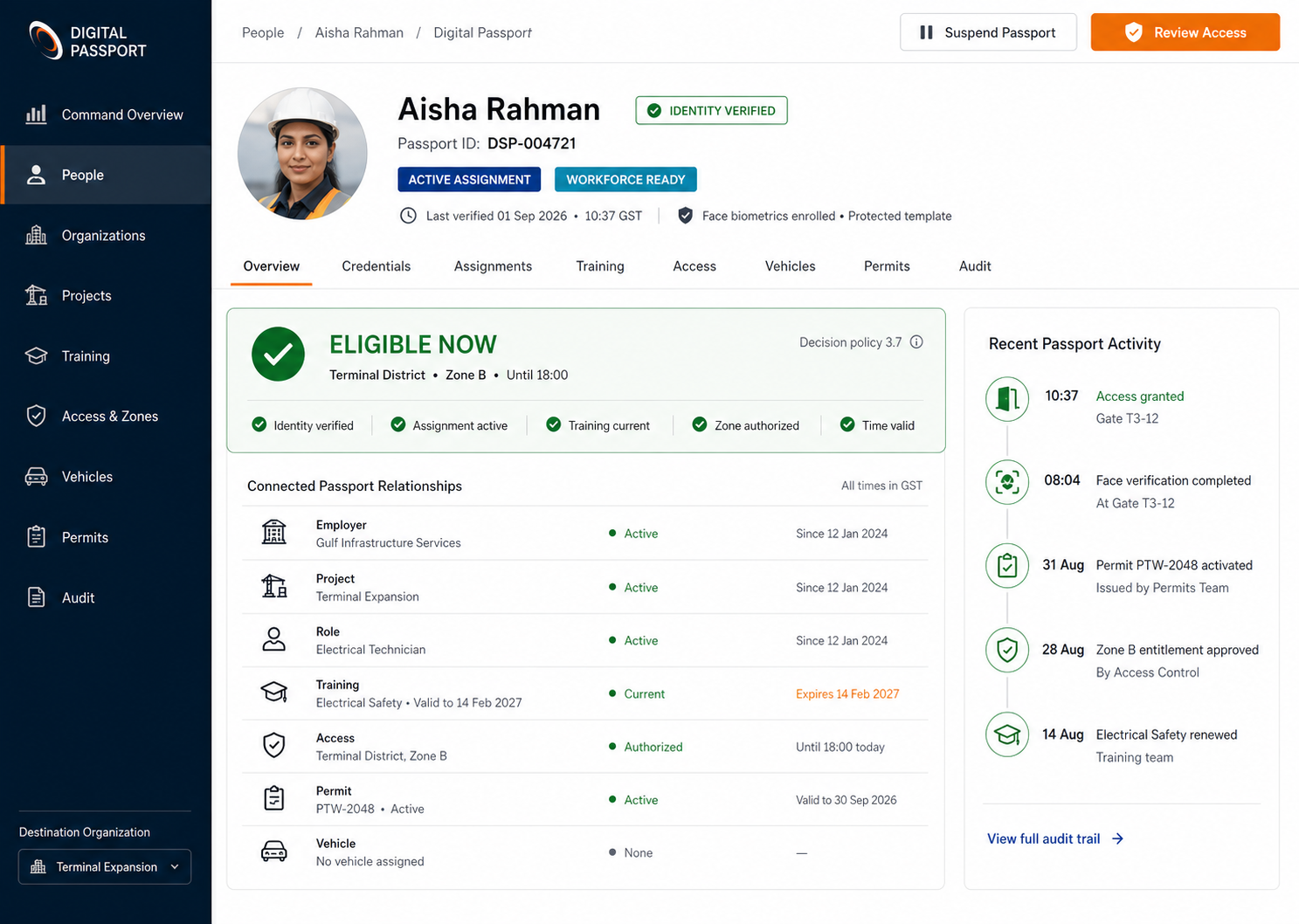
A person is the stable centre of the model, but authorization comes from relationships. “Ahmed is enrolled” is an identity fact. “Ahmed is employed by an approved service provider, assigned to compressor maintenance at Plant 2, trained for the role, named on an active permit, and allowed through Gate 4 until 18:00” is an authorization context.
One resolved subject with identifiers, assurance history, and approved verification methods.
Employer, contractor, tenant, host, sponsor, service provider, or government authority.
Job function, project, work order, visit, delivery, shift, or operational responsibility.
Training, induction, competence, documents, declarations, and applicable restrictions.
Controlled work, approved visit, maintenance activity, escort condition, or another authorized purpose.
Estate, site, zone, door, vehicle, equipment, route, or temporary work location.
Effective dates, schedules, expiry, suspension, emergency mode, and current operational state.
Verification, decision, passage, exception, approval, synchronization, and review history.
Employees, contractors, visitors, drivers, and service providers need different policies
A common identity model does not mean a common journey. An employee may inherit access from employment, role, shift, and department. A contractor may require company approval, project assignment, induction, competence, and a sponsor. A visitor may need an invitation, host approval, identity check, watchlist policy, and escort. A driver may need a delivery booking, vehicle relationship, route, cargo checks, and time slot.
The passport should normalize only what improves trust—identity, relationship, entitlement, status, and evidence—while allowing each population to keep the workflow and policy appropriate to its risk.
Identity verification and authorization are different decisions
Biometric verification can strengthen confidence that the person at a checkpoint is the enrolled subject. It should not turn identity into permission. A successful face, fingerprint, iris, or palm result is one input to the decision; the system must still evaluate current entitlement.
This separation follows a central zero-trust idea. NIST SP 800-207 states that trust should not be granted implicitly from network location or asset ownership and that authentication and authorization are discrete functions performed before access to a resource. CISA's Zero Trust Maturity Model similarly emphasizes granting the right access to the right resource at the right time and for the right purpose, informed by context and continuous validation. A physical estate can use the same reasoning at gates, doors, work areas, and mobile checkpoints.
A continuous authorization lifecycle
Link the person to one governed record and approved credentials or biometric references.
Read authoritative employment, contractor, visit, training, permit, vehicle, and restriction status.
Apply site, population, purpose, zone, time, risk, escort, and emergency rules.
Create a scoped decision with explicit audience, permissions, validity, version, and revocation conditions.
Confirm the person and device, then let the local controller or authorized officer enforce the decision.
Capture the decision, reason, policy, checkpoint, passage, exception, and responsible actor.
Respond when employment, assignment, training, permit, threat level, or operating condition changes.
Remove access deliberately and reconcile edge systems instead of relying on forgotten badges.
Permission to enter is not permission to perform work
A person may be allowed onto an industrial site but not into a process area. They may enter that area but not perform electrical isolation. They may be named on a permit but only while the permit is issued, the worksite is released, required roles are present, and conditions remain valid. The passport can connect these decisions while keeping them distinct.
For example, Biometriya ePTW can remain authoritative for permit status and roles; the passport can use a scoped status when access policy requires it. The gate does not become a permit system, and the permit system does not directly operate every door.
Central policy should meet local, resilient enforcement
A complex estate needs consistent governance without making every door dependent on a permanent remote connection. The design can centralize identity resolution, policy ownership, entitlement generation, reporting, and revocation while keeping time-critical enforcement near the gate or field checkpoint.
- Resolve people and authoritative relationships
- Evaluate enterprise, site, and population policy
- Issue signed, audience-scoped entitlements
- Distribute revocation and configuration changes
- Monitor exceptions, drift, access, and assurance
- Authenticate the device and verify the person
- Check entitlement validity, audience, zone, and direction
- Apply controller, anti-passback, and emergency rules
- Operate within explicit offline limits
- Record passage and synchronize ordered evidence
Open standards can help at the boundary. The Security Industry Association's Open Supervised Device Protocol addresses interoperable communication between access-control readers and control panels and includes a Secure Channel option. That protocol does not create the passport, but it illustrates why the final device-to-controller link should also be supervised and secured. At the industrial governance level, IEC 62443-2-1:2024 describes the security program requirements expected of asset owners responsible for industrial automation and control systems. A Digital Security Passport deployed around industrial operations should be governed within—not outside—that wider security program.
Offline operation is a policy, not a checkbox
When connectivity is lost, the local system needs to know which identities and entitlements may remain usable, their maximum age, what changes require immediate revocation, which high-risk zones must fail closed, how emergency access works, and how events will be reconciled. A cryptographically protected entitlement with a short validity period can reduce dependence on continuous connectivity, but it does not remove the need for clock integrity, device security, revocation handling, and recovery tests.

Privacy and governance must be designed into the passport
A connected view is powerful precisely because it can reveal identity, employment, movement, training, permits, vehicles, and security events. That makes governance a core design function rather than a policy document added after deployment.
- Purpose limitation: define which security and operational decisions the passport supports; do not make it a general employee-surveillance record.
- Data minimization: distribute a decision or status when the checkpoint does not need the complete source document.
- Role separation: security, HR, safety, procurement, hosts, service providers, and administrators should see and change only what their responsibilities require.
- Biometric protection: separate biometric references from general profile data where practical, encrypt them, control exports, log access, and define deletion and re-enrollment.
- Retention by record type: an entitlement, biometric reference, access event, permit record, investigation file, and visitor document do not need one universal retention period.
- Proportionate alternatives: provide approved assisted or non-biometric routes where policy, accessibility, law, or operational circumstances require them.
- Explainability: keep reason codes and source lineage so authorized reviewers can understand a grant, denial, revocation, or exception.
NIST SP 800-63-4 is written for digital identity services rather than physical access, but its separation of identity proofing, authentication, and federation—and its attention to privacy, security, and user experience—provides a useful discipline. Apply relevant principles deliberately; do not claim that a physical-security solution is certified to a guideline merely because its architecture borrows those concepts.
Measure control quality, not just successful entries
Useful measures include duplicate identities resolved, time from source-system change to edge enforcement, active access without a current purpose, revocation latency, expired entitlements attempted, first-time verification success, manual override rate, offline operation time, stale cache age, unknown presence states, exceptions by reason, and the percentage of decisions with complete policy and source lineage.
How to implement a Digital Security Passport without replacing everything
- Choose one material journey. Start with a population and decision whose current fragmentation creates measurable risk—for example contractor entry to an industrial zone, recurring service providers across a campus, or employees and visitors across multiple buildings.
- Name the authorities. Document which platform owns identity, organization, training, assignment, visit, permit, vehicle, credential, zone, and passage state. Resolve ownership conflicts before integration.
- Define the decision contract. State what the checkpoint asks, which facts it consumes, how current they must be, the result and reason codes returned, and what evidence is retained.
- Resolve one person. Establish matching, duplicate review, authoritative identifiers, enrollment correction, and lifecycle rules across repeated visits, employers, projects, and sites.
- Separate verification from entitlement. Design how the person proves presence and how policy grants permission. Test biometric and non-biometric exception routes.
- Engineer edge resilience. Set entitlement lifetime, cache scope, revocation priority, offline zone policy, device trust, synchronization, and recovery behavior.
- Pilot with real exceptions. Include expired training, company suspension, missing host, changed permit, damaged fingerprint, face-capture failure, lost network, clock drift, emergency mode, and attempted use at the wrong site.
- Expand by relationship—not by copying data. Add populations, sites, and systems only after the identity model, policy ownership, evidence, and support process work at the first scope.
For any person standing at any controlled point, can the organization explain: who was verified, which current relationship justified the request, which policy and source facts produced the decision, what the local checkpoint enforced, what occurred physically, and when the entitlement will be re-evaluated or removed?
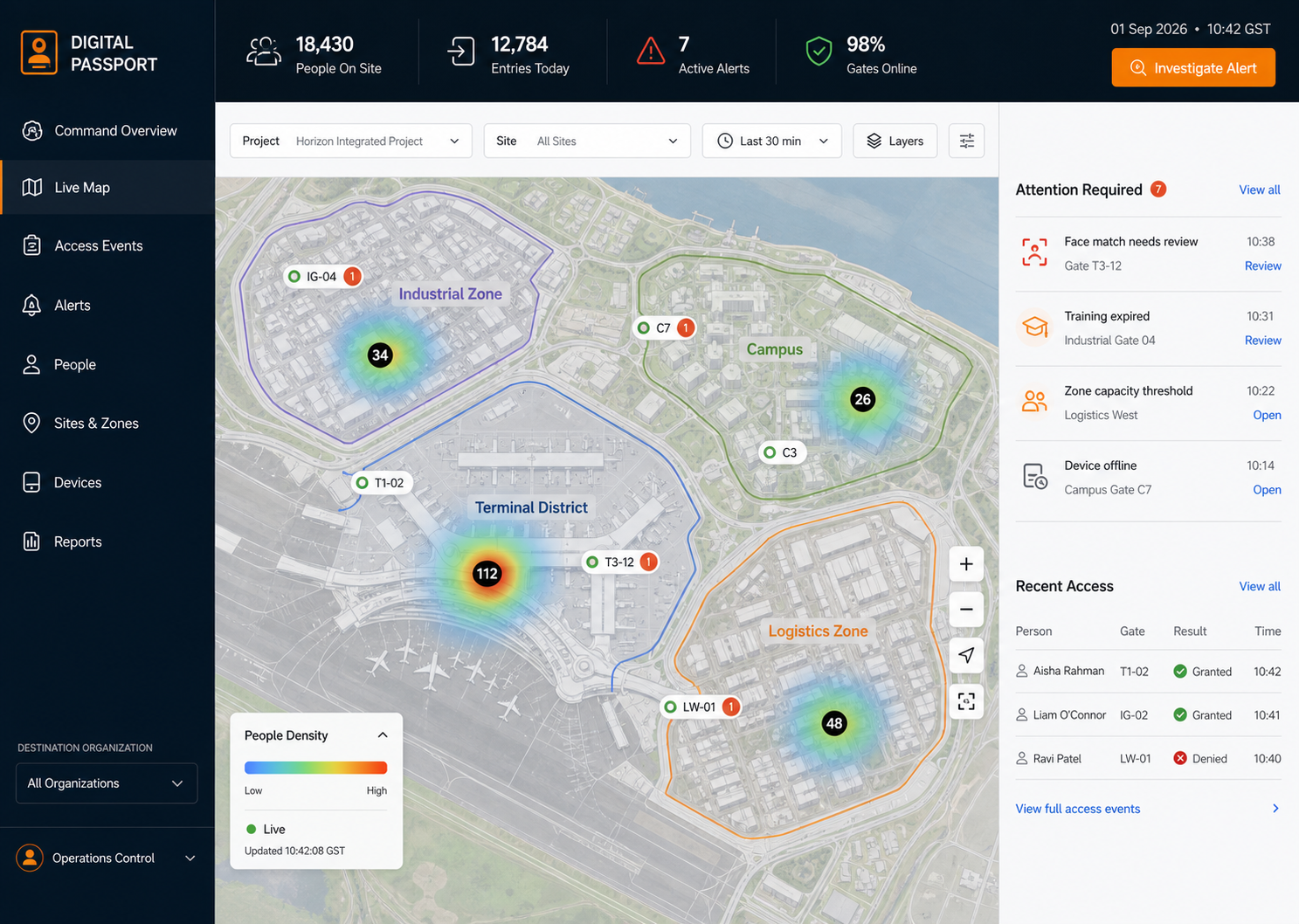
The Biometriya Digital Security Passport is designed around this connected model. It brings identity, relationships, compliance, permits, access entitlements, biometric verification, fixed and mobile checkpoints, operational visibility, and decision evidence into one governed trust layer while allowing authoritative systems and local access infrastructure to retain their proper roles.
Frequently asked questions
Is a Digital Security Passport a government passport or travel credential?
No. In this physical-security context, it is an enterprise identity and authorization record. It links a person to current roles, assignments, readiness, permits, places, and evidence. It does not replace a national identity document or e-passport.
Does it replace HR, access control, visitor management, contractor management, or ePTW?
It should not. Those systems remain authoritative for the functions they understand. The passport resolves the person, consumes the minimum current facts, applies policy, distributes scoped entitlements, and preserves decision evidence across them.
Is biometric verification mandatory?
No. Biometrics can strengthen the link between the person and the passport at high-value checkpoints, but the appropriate method depends on assurance, population, environment, law, accessibility, and operational need. Credentials and approved assisted verification can also be part of the design.
Can a Digital Security Passport work when a site is offline?
Yes, if offline operation is explicitly engineered. Local systems need protected entitlements, clear validity, trusted clocks, device authentication, zone-specific fail rules, queued evidence, revocation strategy, and tested reconciliation when connectivity returns.
How is it different from a digital identity?
A digital identity represents a subject and the attributes or credentials used to establish and authenticate that subject. A Digital Security Passport applies identity to physical-security relationships and current authorization: why the person is present, what conditions are satisfied, where they may go, for how long, and which evidence supports the decision.
What is the best first rollout?
Choose one journey where several systems contribute to a consequential decision and where expiry or revocation matters. Contractor access to a controlled industrial site is often a strong starting point because company approval, worker identity, training, assignment, permits, zones, time, and physical passage must all align.
Reference standards and independent resources
- NIST SP 800-63-4: Digital Identity Guidelines — the 2025 final guidelines for identity proofing, authentication, federation, security, privacy, and user experience.
- NIST SP 800-207: Zero Trust Architecture — resource-focused trust, discrete authentication and authorization, and dynamic policy concepts.
- CISA Zero Trust Maturity Model, Version 2.0 — identity, devices, networks, applications, and data maturity, with cross-cutting visibility, automation, and governance.
- NIST NCCoE SP 1800-2: Identity and Access Management — a practice guide addressing fragmented identities across physical, business, and operational systems.
- Security Industry Association: Open Supervised Device Protocol — an access-control communications standard supporting interoperability and supervised, secure reader-to-panel communication.
- IEC 62443-2-1:2024 — security program requirements for industrial automation and control system asset owners.