Biometriya Digital Security Passport
One trusted identity across every controlled environment
A unified identity, compliance, and authorization solution for complex estates
Connect the person, employer, project, role, training, permit, credential, zone, and access decision without replacing the systems that already own those records. Every decision stays current, explainable, and ready for audit.
Canonical identity
Live eligibility
Explainable decisions
Offline resilience

Digital Passport
Identity eligible now
- AffiliationActive
- TrainingCurrent
- Zone and scheduleApproved

The estate-wide identity problem
Contract endsAccess and delegated authority must expire
Training expiresAffected entitlements must be recalculated
Provider changesOld scope and privileges must be withdrawn
Network failsApproved local operations must continue safely
Complex estates create risk between systems
Identity, safety, access, provider, and project data often change independently. A credential that worked yesterday may no longer represent a valid relationship today.
A durable identity profile
The identity persists while every relationship can change
One canonical person ID connects operational relationships without merging every source system into a new data silo. When one relationship changes, Biometriya recalculates the entitlements that depend on it.
Digital PassportOne canonical person ID
Verified identity with current relationships, policy outcomes, and decision evidence.
Connect verified biographic and biometric evidence to one canonical person record.
Know which employer, contractor, authority, provider, or sponsor currently stands behind the person.
Keep active assignments, work packages, responsibilities, and validity dates connected to identity.
Use current competency evidence as a live condition in access and work decisions.
Bind cards, mobile credentials, face, palm, or other biometric references to the same person.
Apply site, building, zone, shift, time, and access-point rules from current policy.
Connect drivers, vehicles, appointments, hosts, destinations, and approved time windows.
Confirm whether the person may perform a controlled task without confusing work permission with site entry.
Continuous authorization lifecycle
Permissions adapt as people and work change
The Passport turns registration, identity proofing, readiness, policy, and enforcement into one continuous record for employees, contractors, visitors, drivers, and security teams.
Receive the person from a sponsor, employer, provider, visitor journey, or authoritative source system.
Verify identity evidence, check for duplicates, and bind the approved biometric or credential.
Connect project, role, training, certification, sponsor, destination, and work context.
Send scope-limited, time-bound permissions to the systems and sites that need them.
Apply the decision at a gate, workplace, visitor checkpoint, vehicle lane, or mobile field check.
Expire, suspend, revoke, or route for review when a contract, permit, training record, or assignment changes.
Connected operational capabilities
One identity connects every operational layer
The Digital Security Passport brings separate identity journeys into one governed authorization model while each business system continues to own its authoritative data.
Maintain one durable person record while credentials, employers, assignments, and access methods change.
Delegate defined services and operating scope without giving up ownership of identity, policy, or evidence.
Use affiliation, role, project, sponsor, contract dates, and joiner, mover, or leaver events to determine eligibility.
Keep permission to enter and permission to perform a controlled task separate, but connected to the same identity.
Coordinate hosts, meeting rooms, invitations, arrival verification, notifications, and time-bound access.
Turn expiry and competency status into active authorization conditions instead of passive documents.
Calculate entitlement centrally while certified local controllers retain responsibility for the physical unlock.
Use the plate together with driver, appointment, destination, and time before deciding vehicle access.
Retain the trusted facts, policy version, reason code, access point, and authorized override behind each outcome.
Two coordinated decisions
Site entryMay enter this zone
Controlled workMay perform this task
Site access is not permission to work
A person may be eligible to enter a zone without being authorized to perform a controlled task. The Passport keeps entry and work authorization separate while using the same verified person, current policy, and audit history.
Identity, affiliation, assignment, schedule, and access policy are current.
The permit is active and the named worker satisfies the required controls.
Operational safeguard: suspending a permit stops the controlled task without automatically removing unrelated site access.

Verification wherever work happens
Use the same identity, policy, and evidence model at fixed and mobile checkpoints
Match the verification channel to the environment without creating separate identities or disconnected decision histories.


Operational and management visibility
See where attention is needed and why a decision was made
Live operations, executive assurance, and the connected person passport provide different views of the same governed identity and evidence model.
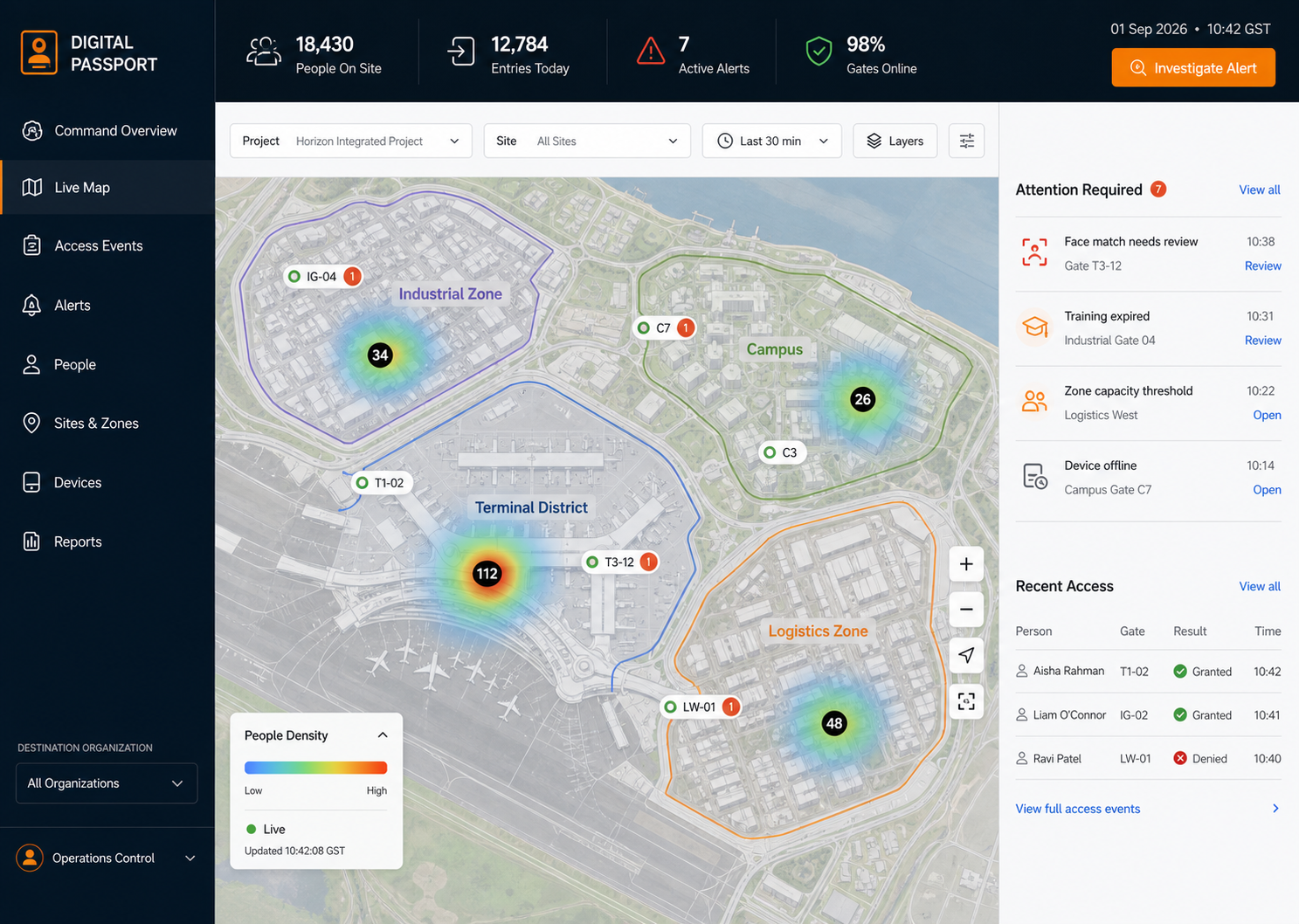
Operations teams can see where people are, which areas need attention, and what happened next.
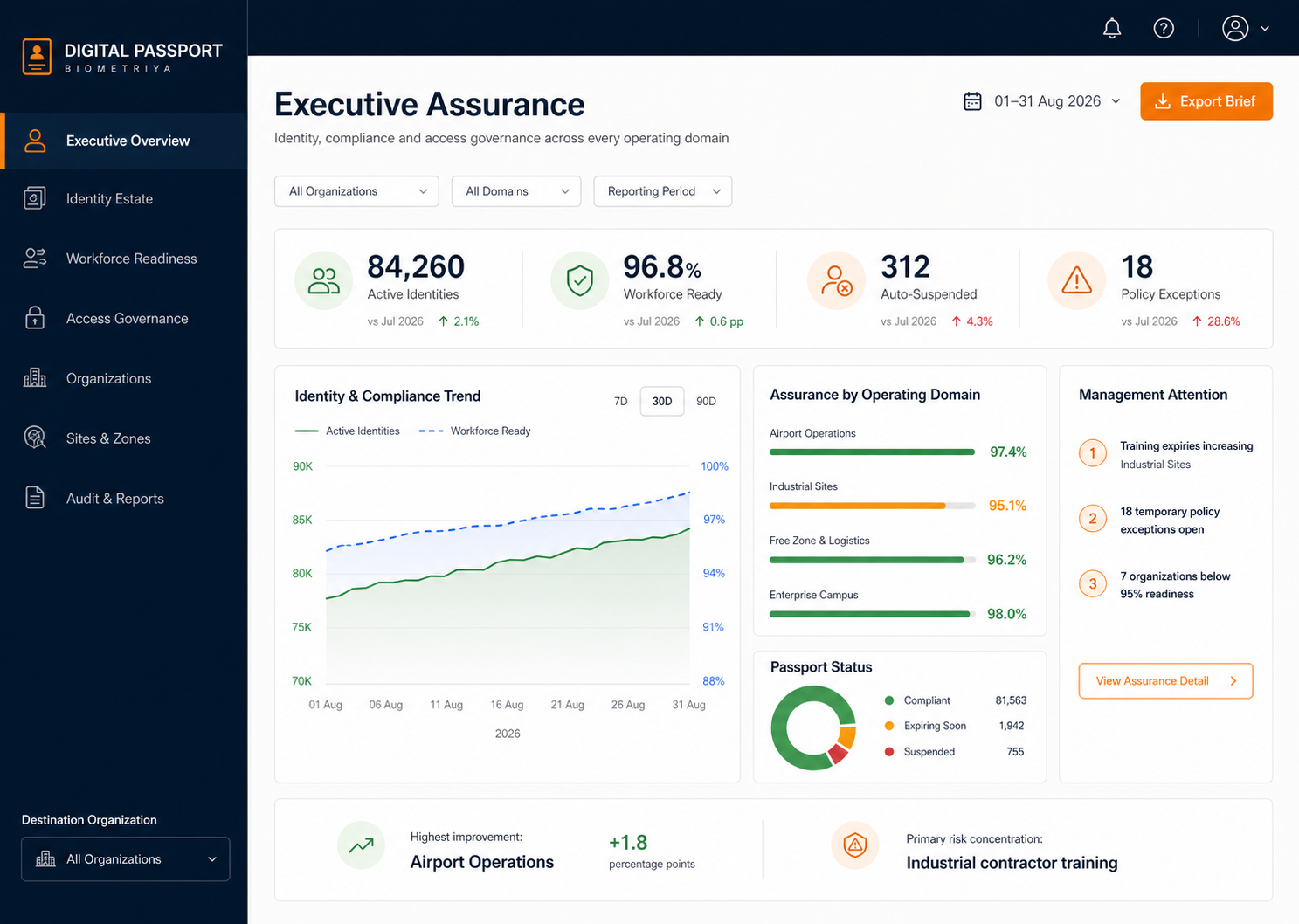
Management can review whether identity, training, and policy controls are working across the estate.
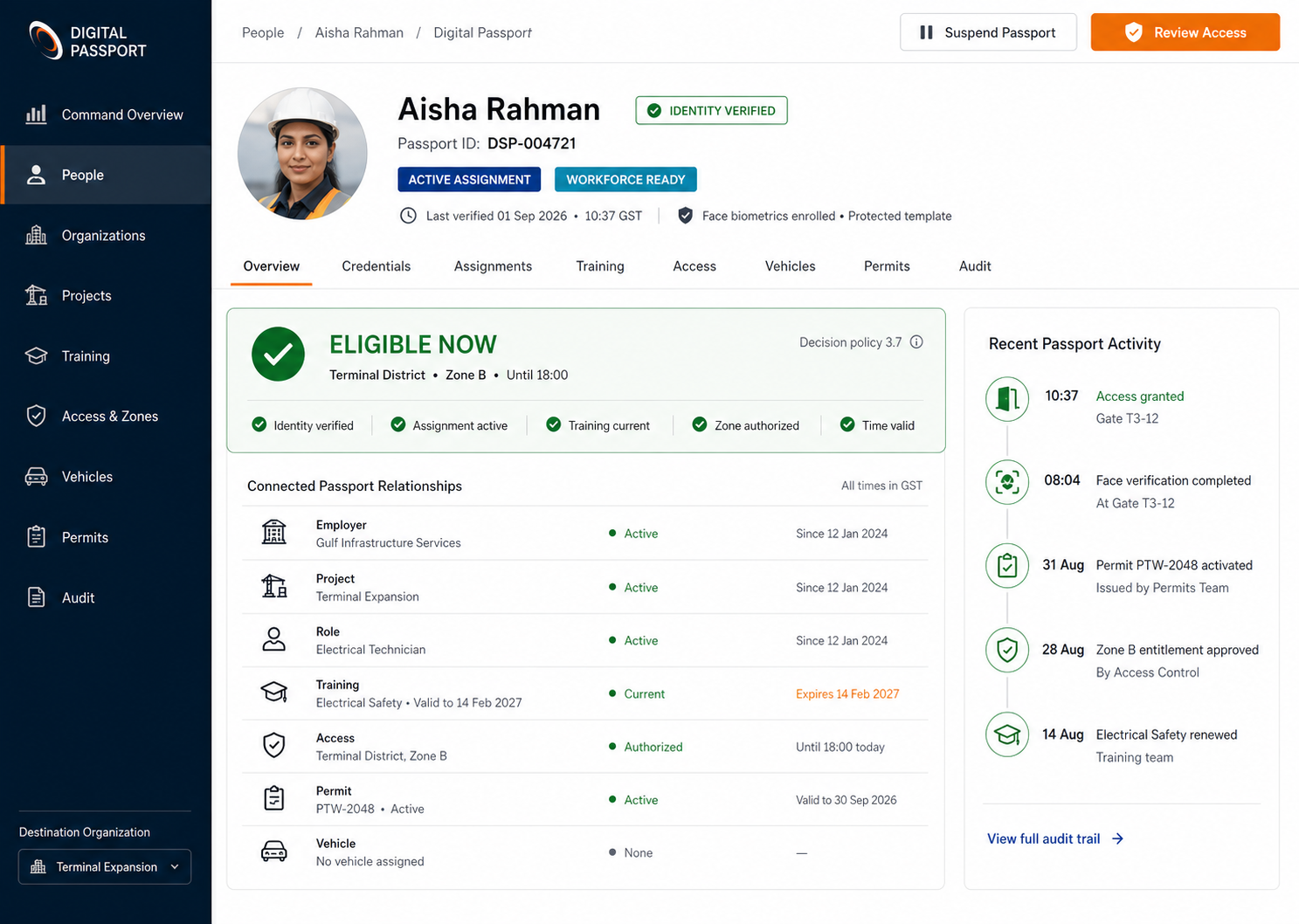
Authorized teams can understand who the person is, what is active now, and why access was granted or denied.
A governed trust layer
Unify the systems you trust without replacing them
The Passport consumes authoritative facts, applies versioned policy, distributes only the entitlement needed at each edge, and preserves evidence for review.
HR, contractor, learning, training, and certification platforms remain authoritative for their records.
PACS, controllers, gates, terminals, and credentials receive the entitlements needed for local enforcement.
Video management, command centres, SIEM, fire systems, and building systems consume governed identity events.
Visitor management, ePTW, appointments, mustering, and operational applications share one identity context.
ANPR, lanes, delivery schedules, driver identity, and destination policy contribute to the access decision.
Scope-minimized, signed, time-limited policy supports agreed offline operation and later reconciliation.
Designed around your estate
Define the identity, governance, and authorization model before choosing the rollout path
Biometriya can map your priority domains, authoritative systems, provider responsibilities, privacy rules, biometric channels, edge resilience, and implementation sequence.
- Start with a priority journey such as contractors, visitors, workforce access, permits, or vehicles.
- Connect existing investments across HR, learning, access control, security, and operational platforms.
- Define policy ownership clearly across the client, authorities, sites, and approved service providers.
- Expand one governed identity model across projects, facilities, and business domains over time.